
Digital marketing has become more than creativity, combining innovation, technology, and precision. In the race to capture online customers, the future winners will be those who include AI into marketing, utilize automation marketing tools, and adopt data-based marketing to understand customers.
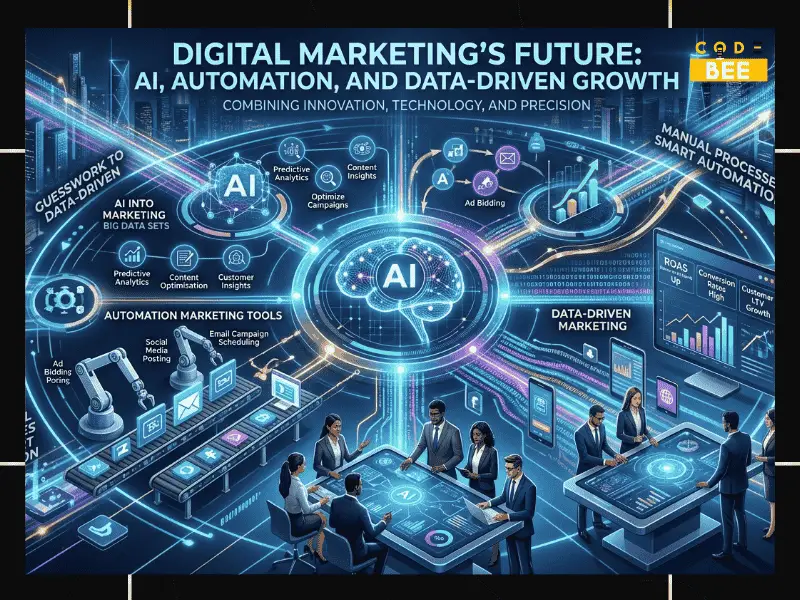
The transformation is evident. Marketing has changed from guesswork to data-driven decision making, from tedious manual processes to smart automation and effective targeting to personalised marketing.
AI Is Redefining Marketing Intelligence
Artificial Intelligence is not just a buzzword; it is shaping today’s modern marketing strategies. AI is making predictive analytics and AI-assisted content creation of today possible.
Marketing AI has the ability to analyze and act on massive data sets, identify and act on patterns, and predict and respond to customer behavior. AI allows marketers to design personalised marketing campaigns that reach and influence target customers. Marketing AI tailors product suggestions, email campaigns, and even chatbots to be more relevant to individual customers.
Voice search optimisation and AI search engines are changing ways how users search for information online. Companies that rework their websites for this new audience focus will stand to benefit the most.
Automation Is Driving Efficient Work at Scale
Marketing automation helps you build an efficient workforce, and just like an efficient employee. Marketing automation platforms help you streamline repetitive tasks like email marketing, social media scheduling, and the lead nurturing processes.
With automation, you achieve not just time-saving but also consistent marketing processes. Automated email marketing helps you send the right email at the right time automatically. When integrated with a CRM, it helps you achieve better management of your customers’ journey.
Another advantage of automation is scalability. It allows you to achieve the same (or better) for each individual customer, doing an enormous quantity of work.
Data-Driven Marketing Is The Standard Model
The data marketing model has great potential in all marketing models. Modern marketing based on data is easier to make decisions, optimise processes and achieve a cheaper return on investment to individual marketing.
Marketers can observe user behavior, evaluate the success of their campaigns, and pinpoint areas needing improvement thanks to tools like Google Analytics 4 (GA4) and sophisticated tracking tools. Such understanding enables businesses to move their attention from superficial indicators to significant results like conversions and retention of customers.
Due to growing privacy concerns, a trend in first-party data collection is apparent. Businesses are now focusing on collecting data from their audience directly. They collect data from interactions on company websites, company mobile apps, and the company’s customer interactions.
Increasing Personalization and Improving Customer Experience
Today’s consumers demand advertisements, and they expect businesses to provide experiences instead. Customer experience (CX) optimization and hyper personalization is how businesses better their services to meet consumer demand.
Businesses should expect to harness the powers of artificial intelligence, automation, and data insights to provide consumers with personalized recommendations and journeys. Interaction with websites is more attractive and relevant when the overall experience is engaging.
Moreover, the popularity of omnichannel marketing strategies is on the rise. Customers communicate with brands on a wide range of platforms, including websites, social media, emails, and mobile apps. Building customer trust and loyalty is facilitated by a consistent experience across all channels.
Emerging Trends
There are several trends shaping the future of digital marketing, including:
- Faster content creation using AI content creation tools
- Short video form marketing, live streaming, and video marketing
- Influencer marketing
- No click searches that provide snippets of leading search results
- Content that Interacts, including quizzes, polls, and augmented reality experiences
These trends indicate more engaging, interactive, and user-focused marketing strategies.
Conclusions
Digital marketing will rely on the use of technology to enhance human creativity, rather than human creativity being sidelined. Those businesses that are able to embrace AI in digital marketing, apply marketing automation strategies, and use data to drive their decisions will be better able at developing and grow.
The evolution of the digital marketing space requires businesses to be flexible and technology-driven. Above all, businesses will need to focus their activities on meeting the needs of their target audience.
In the current marketing era, a business’s marketing strategies should not only focus on communicating with the target audience. Instead, the focus should be on developing a relationship with the right audience and helping them to grow.