
Taking your idea to a live mobile application is like planting a seed and watching it grow into an interactive and impactful tool. Mobile app development is a creative and strategic journey that can benefit from understanding the role of AI in digital marketing. This guide gives you clarity and practicality to get you to the app store.
1. Start with an Idea
Every app that is a success begins with a strong idea. But not all ideas are executed well in the commercial space. Ask yourself:
- What problem does my app solve?
- Who is my target audience?
- What makes my idea unique?
Do not rush this stage. Your app idea is the blueprint. The clearer it is, the easier it will be to develop.
2. Concept Validation
Before developing your app, you need to evaluate your idea. This can be:
- Surveys
- Interviews
- Competition analysis
- Landing page to evaluate traction
Early feedback from users is important. If people are showing traction, you are on the correct path.
3. Define the features and functionality
Now you need to start defining what exactly the app is going to do. Start by determining what the Minimum Viable Product (MVP) is going to be. This is the most basic version of the app, which includes the most basic, necessary features.
For example, this could be:
- User registration and/or logging in
- Core functionality (this is the main feature of the app)
- User-friendly and simple interface
Don’t do too many features, and get too carried away. Start small and grow from there. The largest and most complex apps began with simple versions, and gradually built up to where they are now.
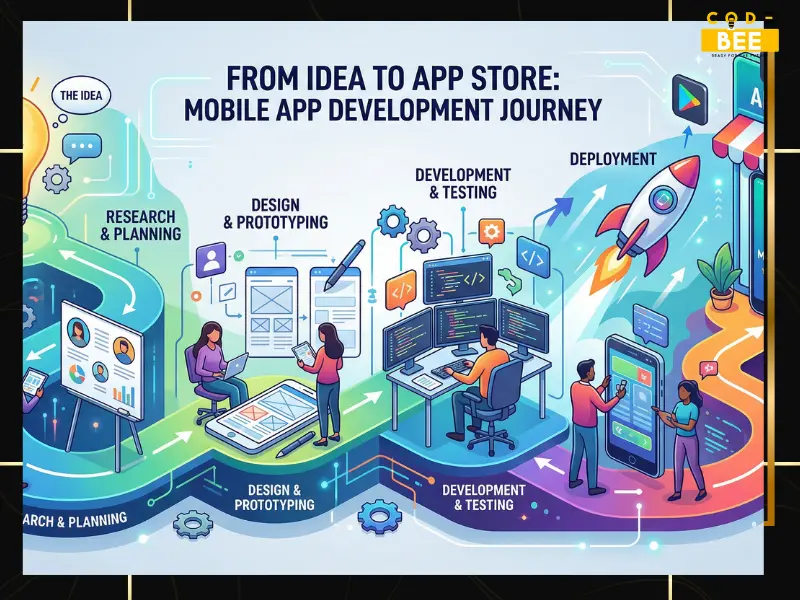
4. User Experience (UX) and User Interface (UI) Design
This is where the app visually starts to come together. Good design is more than just being visually appealing, and includes how users are going to interact with the app.
Key components include:
- Seamless and clear navigation
- Simple and clean layout
- Speed, and fast loading time
User experience (UX) can make or break the app. The smoother and clearer the process is, the more likely users are to enjoy the app. Complicated or confusing processes (and features) are likely to drive users away or get them to stop using the app after they’ve tried it once.
5. Determine the Development Approach
You have several options at this stage:
- Native apps that are based on Android or iOS
- Cross-Platform apps (with one codebase for both)
- Hybrid options
Each of these options have their unique benefits and drawbacks, depending on the budget, timeline, and goals. The ideal option will be the most efficient and reliable, based on what your expectations are.
6. Development Stage
Now the actual building of the app is going to happen. Developers turn the designs and plans into an operational app.
The typical steps include:
- Frontend development (The part of the application that users interact with)
- Backend development (The part of the application that the users do not see such as servers, databases, and the logic of the application)
- API integrations
Ongoing development testing. Identify and fix issues as early as possible to avoid future problems.
7. Testing and Quality Assurance
Your application cannot be released without testing. This ensures that:
- There are no significant bugs (critical bugs), and there are no crashes (non-critical bugs)
- It runs smoothly
- It is compatible with all devices
There are different types of testing, such as:
- Functional testing.
- Usability testing.
- Performance testing.
This is the final polish to the application before it goes live.
8. Publish To The App Store
Now the fun part! You can now publish your application.
To publish the app, you must have:
- Developer accounts for the App Store and Google Play.
- A description of the app and screenshots.
- It must be categorised correctly.
Your app listing must be your best work. It is the first impression users will have of your app.
9. Marketing and User Acquisition
Building the app is only half the job. You need to have users.
This can be most effectively achieved with:
- Social media ads
- Influencer promotion
- App Store Optimization (ASO)
- Paid ads
A good app without visibility is as good as a bad app.
10. Support and Upgrades After The App Launch
The launch of the app is only the beginning. You will need to keep evolving the app and keep track of how people interact with it.
Focus on:
- Identifying and resolving bugs
- Implementing additional features
- Optimizing system performance
Feedback from users will guide future system updates.
Final Thoughts
Developing a mobile application is more than a technical process. While there are a number of coding skills that go into making a mobile application, there are also a number of creative skills. Each part of the process has a number of different creative skills that go into the making of a mobile application. Each part of the application has a number of iterative, experimental, and educational skills that go into the process.
If you have an idea, there is no better time than now to turn your idea into a working mobile application.