
Advertisements are expensive and are becoming even more costly. Relying on ads solely for leads can ruin your budget. Fortunately, there are strategies that will allow your IT company to generate leads without advertisements and will allow you to do it on a consistent basis.
Let’s explore how to generate leads without spending on advertisements.
1. Lay a Good SEO Foundation
Without any doubt, the most valuable resource for lead generation is search engines. The first place to start is search engines, organic leads and SEO. Your business can rank for high-volume keywords that your target audience is searching for.
Begin with:
- Keyword research
- On-page optimization
- Technical SEO
When you rank for your target keywords, your website will be a fully funded lead magnet sponsored within your budget.
2. Build High-Value Content That Provides Solutions
You should consider content to be your personal automated salesperson. Content in the form of blogs, guides, and case studies helps your brand be recognised as an authority for keywords “digital marketing for IT companies” and “B2B lead generation strategies”.
Here is what you should prioritise:
- Step-by-step guide
- Insights and trends for the specific industry
- Target client problem-solving
When your content provides answers to questions people actually have, you drive demand and highly qualified leads to your business who trust your knowledge.
3. Use LinkedIn for B2B Lead Generation
LinkedIn is an absolute goldmine for IT businesses. It is the platform where decision makers scroll, assess, and connect.
Use the following LinkedIn lead generation techniques:
- Thought leadership posts
- Posts where you comment on and contribute to industry-relevant conversations
- Articles that demonstrate your expertise
- Incorporating relevant keywords into your company page description
All the effort you put into consistent posts should help build your reputation and result in leads coming to you, without the need to pay for ads.
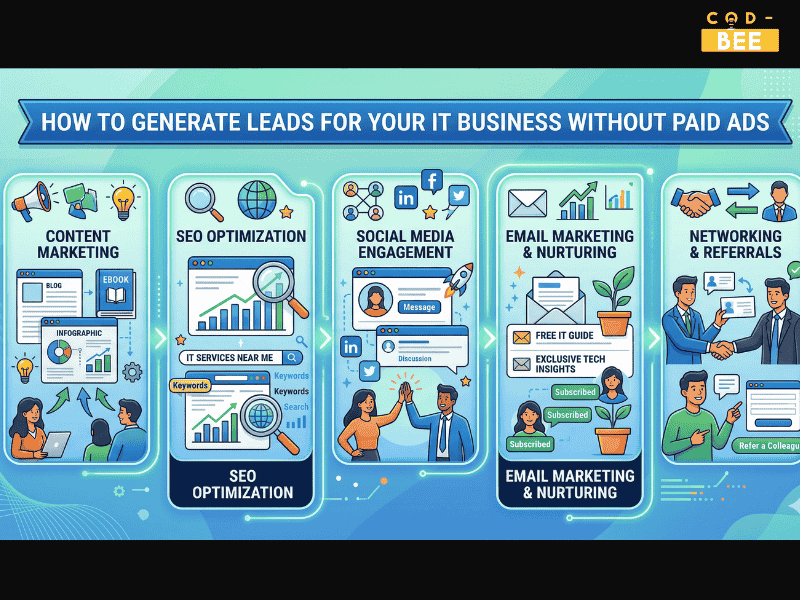
4. Optimize Your Website to Maximize Conversions
Traffic without conversion is like a shop without a buyer. Your website should drive the customers to do something.
Make sure to have:
- A clear CTA
- Contact forms that are as short as possible
- Landing pages that are converted for IT services
- Credibility builders (case studies, testimonials)
A website that is fully optimised stands the highest chance of converting your free traffic into business.
5. Use Local SEO to Target Nearby Clients
When your IT business targets specific geographical areas, local SEO is a highly efficient and free lead generation technique.
Optimise your business for local SEO:
- Create your Google business profile
- Target keywords like IT support services in Los Angeles and similar business location keywords
- Citations on local business directories
This ensures that your business shows when potential customers are searching quite close to your business.
6. Build Authority with Backlinks
Backlinks are a vote of confidence. Your site becomes more trusted by search engines the more quality sites link to you.
Consider these:
- Guest blogging.
- Collaborating with others in your industry.
- Listing your company in quality business directories.
These strategies will enhance your reputation and improve your organic marketing efforts.
7. Offer Value for Free to Gain Leads
People like to feel they receive value before they have to pay for it. Offering services for free is an excellent strategy for lead generation.
Try these:
- Free website audits.
- Free IT consultations.
- Checklists and guides are offered as downloadable content.
This strategy will build trust and credibility while helping your business in terms of inbound marketing.
Final Thoughts
Generating leads in an organic way and without paying for it is about working smarter, not harder. Streamlined SEO services, content marketing, LinkedIn lead generation, and conversion optimization will create an effective and time-sustainable strategy for your IT business.
At NoxsterSEO, we believe organic growth is like planting a tree. It takes time, but once the tree is fully developed, it will provide resources continuously for a long period of time.