
For many beginners, becoming a developer feels like standing in front of a digital mountain. One side is covered with terms like JavaScript, APIs, databases, frameworks, and Git. The other side is filled with countless job descriptions requesting experience. Without guidance, the beginner tech maze is a colorful distraction and can seem impossible to navigate.
To start a career in app and software development and related fields, you do not need to spend years studying. Breaking the journey into learning milestones, focusing on practical exposure, and extending training courses beyond classroom theory offers the best learning approach. These tactics can help beginners build a job tech skills foundation.
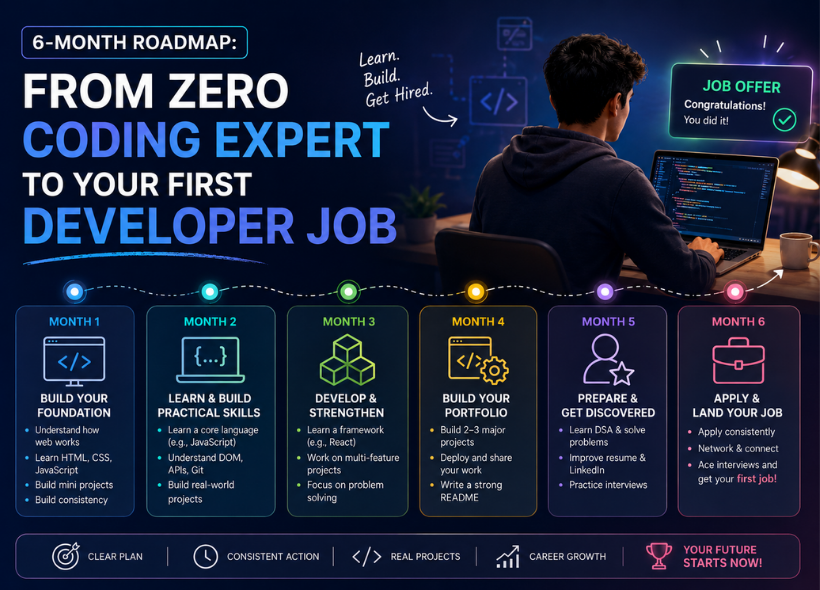
If you are choosing between a 3-month and a 6-month training program, use this roadmap to see what the journey can look like.
Month 1: Learn the Basics and Build Your Foundation
Every Coding building starts and is based on fundamentals as is every building.
In your first 30 days you will be able to understand the following.
- How websites and applications work
- Basic programming
- Variables and data types
- Loops and logic
- Basic problem solving
- HTML
- CSS
Advanced topics should not be the focus of your first 30 days of learning coding. Learning to code is similar to learning an actual language. You don’t start with advanced vocabulary and literature. You build your vocabulary and slowly start learning to communicate.
By the end of the first 30 days you should be able to understand the logic structure of code and build simple web pages.
Month 2: Start Writing Real Code
This is the time when you will play with your keyboard.
In 2nd month your focus will be:
- JavaScript
- Functions
- Arrays
- Basic algorithms
- Responsive design
- Distributed practical projects
Some small projects you can do are:
- Calculator
- To do list
- Your own online portfolio
- Weather app
This is what to expect, simple projects that are possible with coding knowledge, stop with the “I get the ideas” and create with “I did it”.
At this point, learning to code is so practical. Because employers are no longer looking for coding knowledge, they are looking for those who are confident enough to tackle real-world coding problems.
Month 3: Build Industry Skills
Learning and professional work can often be separated by a chasm. This stage helps bridge that gap.
A focused 3-month training program can benefit learners to sharpen specific technical skills.
In 3rd month you will be able to learn::
- Frontend frameworks like React
- APIs and the handling of data
- Git for version control
- Project structures and workflows
At this point, you should have worked on 2 to 3 projects that you can add in your portfolio.
You should present your portfolio as your online shop. If your shop is appealing enough, recruiters might stop by.
Month 4: Enter the Backend World
Every application has a frontend and a backend. Behind your login page is a system working quietly.
In this month you will learn to work with:
- Backend systems
- The basics of databases
- The concepts of servers
- Authentication System
- Creating APIs
You can do more with backend systems, and the world opens to you with full-stack development.
Many companies prefer to hire developers who understand both frontend and backend because projects require flexibility across technologies.
Month 5: Start Working on Real Projects.
By the end of your training you will be working on live projects like:
- Team collaboration
- Real-life environment development
- Identifying and fixing bugs
- Improving code and workflow
- Projects that resemble client work
During this month, students begin to work in a non-classroom environment.
Real projects provide students with a deeper understanding of what it’s actually like to work for a company and the importance of meetings, deadlines, and teamwork. Community discussions about real-life technical training highlight the importance of real work experience compared to theoretical experience.
Month 6: Get Ready to Get Hired as a Developer
This month is your last month to get you prepared for the job.
Work on:
- Build your resume
- Preparing for interviews
- Taking practice coding tests
- Improving your GitHub profile
- Optimizing your LinkedIn
- Participating in mock interviews
Aim to apply for:
- Junior Developer positions
- Frontend Development roles
- Backend Development roles
- Developer Internships
- Entry-level Software Development Jobs
Forget about perfection. If you wait for everything to be perfect, you will be waiting a long time. Most developers begin their careers with a significant amount of learning. Careers in technology usually involve continuous development and growth as opposed to reaching a final destination.
3-Month Training Program or a 6-Month Training Program : Which is Right for You?
The skill level you enter the program with greatly affects which program you should choose.
Choose a 3-month program if you:
- Have some background in coding
- Want to develop a specific skill
- Want to level up more quickly
Choose a 6-month program if you:
- Are a beginner with no coding skills
- Want full and total exposure to the field
- Want to learn through work and be ready to get a job
Structured industrial training helps beginners to become job-ready through added assistance, mentorship, and exposure to real-world projects.
Start Building Your Career With CodeBee Lab
There is no need to be perfect on the first day. The industry rewards those who are consistent and willing to learn.
Here at CodeBee Lab, we offer real-world training focused on the skills and projects from the industry that are important for your career. Whether you want 3 months training to level up your skills, or 6 months training to gain the skills necessary to be career-ready, our courses are designed to get you your first developer position.