

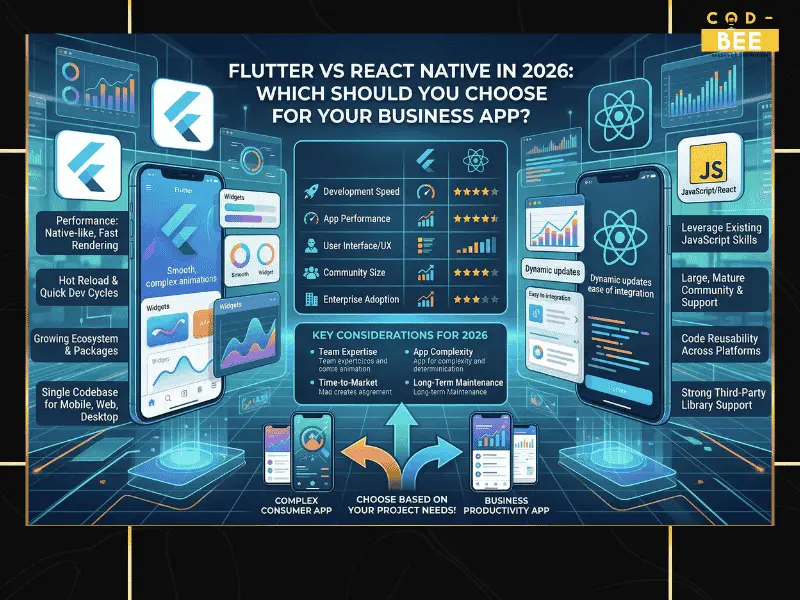
One of the most challenging decisions is deciding between Flutter and React Native for developing a cross-platform mobile application. Both options are fully functional, and each can send apps to both iOS and Android. However, the business needs they address are very different.
Why Flutter VS React Native is more important than ever in 2026
If you’re a business owner, CTO, or start-up founder, one of the very first choices you will have to make in developing a mobile application is whether to use Flutter or React Native.
Both frameworks allow you to develop apps for Android and iOS using a single codebase, and both are backed by major players in the industry (Google for Flutter and Meta (Facebook) for React Native). By 2026, both frameworks have matured enough, leading to the possibility that a wrong choice can lead to the loss of significant sums of money or prolonged development cycles.
This guide will present relevant benchmark data for 2026, along with useful data for relevant markets and a business-oriented decision-making framework to guide you in making the most appropriate choice.
💡 Pro Tip: While a dev’s preference for a framework is a consideration, it should not be a deciding factor. Consider the team’s skill set, the time-to-market expectations, and the UI complexity of the app. These three criteria will be more useful than any benchmark to quickly narrow down your options.
Market Share & Adoption: Who’s Winning in 2026?
The cross-platform app development world has changed a lot lately. Flutter has passed React Native in most popularity metrics; however, React Native still leads in enterprise employment opportunities. Here’s the data:
The Flutter framework has increased its market share from 30% in 2019 to ~46% today. In the same time span, React Native has gradually decreased from its 2019 market share peak at 42%. The numbers don’t tell the whole story, however. The React Native framework is used to develop apps that serve over two billion users, including the whole family of Facebook apps. Flutter drives Google’s products and also a few of their other high-profile consumer apps.
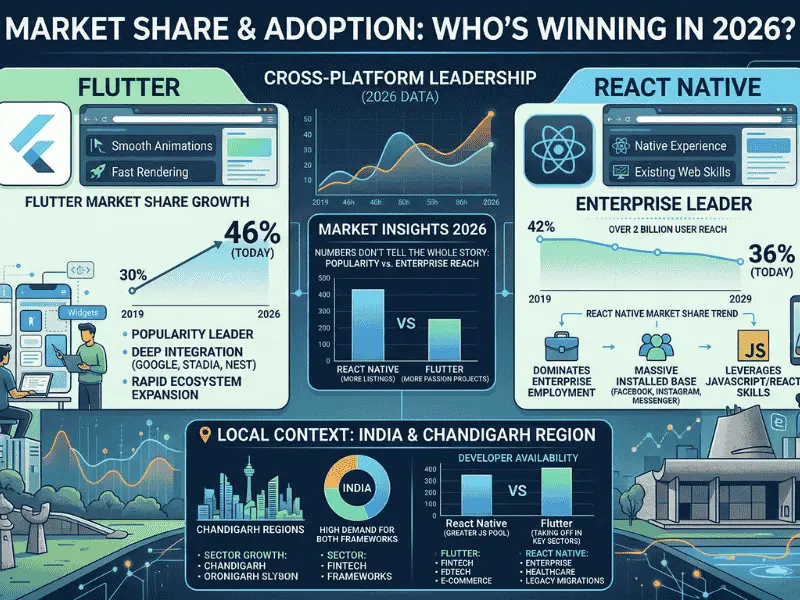
📍 Local Context (India / Chandigarh): In the Indian market, the demand for both frameworks is high. The availability of developers for React Native is greater because of the popularity of the JavaScript language. However, Flutter has begun to take off in the fintech, edtech, and e-commerce app development fields. This is especially true for startups that desire a more premium UI for lower cost.
Performance: Architecture, Speed & Benchmarks
This is where Flutter and React Native diverge most sharply. In order to choose the right tool for the performance criteria of your app, understanding the architecture is essential.
How Flutter Works
For every Flutter application, Dart code gets compiled using an AOT compiler to generate Platform-specific (either ARM or x64) Machine Code. Flutter manufactures its own UI framework. Hence Flutter takes complete control of pixel rendering and drawing through its own rendering engine (Impeller, to replace Skia) and draws each pixel bypassing the UI components of the platform as a result. This is the reason Flutter achieves consistent performance of 60/120 FPS as it manages shaders to avoid compilation jank in animation-heavy applications.
How React Native Works
React Native primarily uses JavaScript and for the purpose of faster application start-up. It uses the Hermes engine, which acts as a JavaScript compiler and converts JavaScript code to bytecode. The Fabric renderer, which is new, along with the JavaScript Interface (JI), replaces the old bridge and allows for direct, synchronous communication with the UI components, thereby closing most of the performance gap.
2026 Quick Comparison
| Factor | 🎯 Flutter | ⚛️ React Native |
| Language | Dart | JavaScript |
| Performance | 120 FPS, AOT compiled | 60 FPS, Hermes engine |
| UI Consistency | Pixel-perfect | Native platform feel |
| App Size | Larger | Smaller |
| Code Reuse | 85–95% | 70–85% |
| Hiring Pool | Smaller (Dart) | Massive (JS devs) |
| Platforms | Mobile + Web + Desktop | Mobile-first |
Which One Is Right for You?
📍 India / Chandigarh: Locally, React Native developers are more readily available. However, Flutter is gaining traction in terms of adoption and use for MVPs of start-ups and e-commerce applications where a premium UI differentiates the offering.
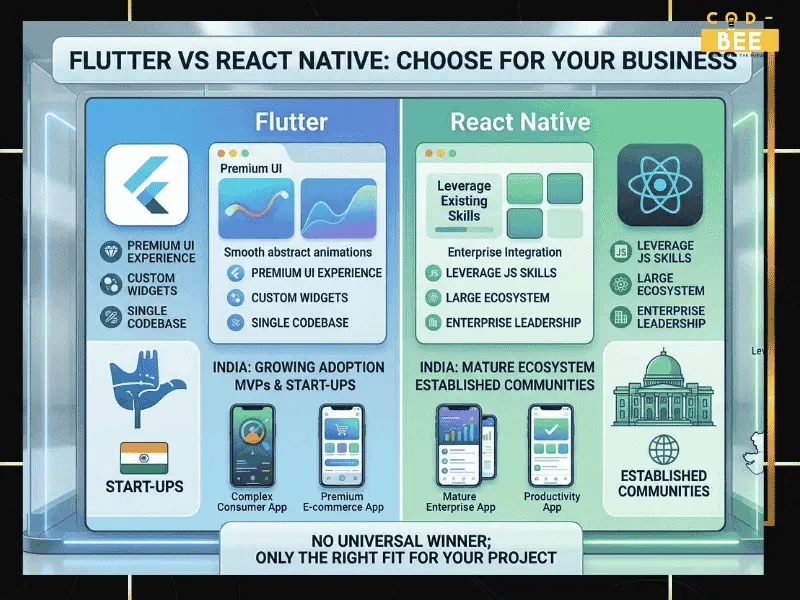
No Universal Winner; Only The Right Fit
While Flutter has the upper hand with performance and UI consistency, React Native possesses the stronger ecosystem and ease of hiring. The optimal application gets developed by a team that is proficient with the framework and aligned with your business objectives.