
The website design trends in 2026 and beyond becomes quieter, sharper, and simpler. It almost feels websites are breathing with their user. It is one of the many things I’ve learned from constantly browsing, testing and developing websites. Web design trend is no longer just about pricing. It is about picking the right handbook which feels about right.
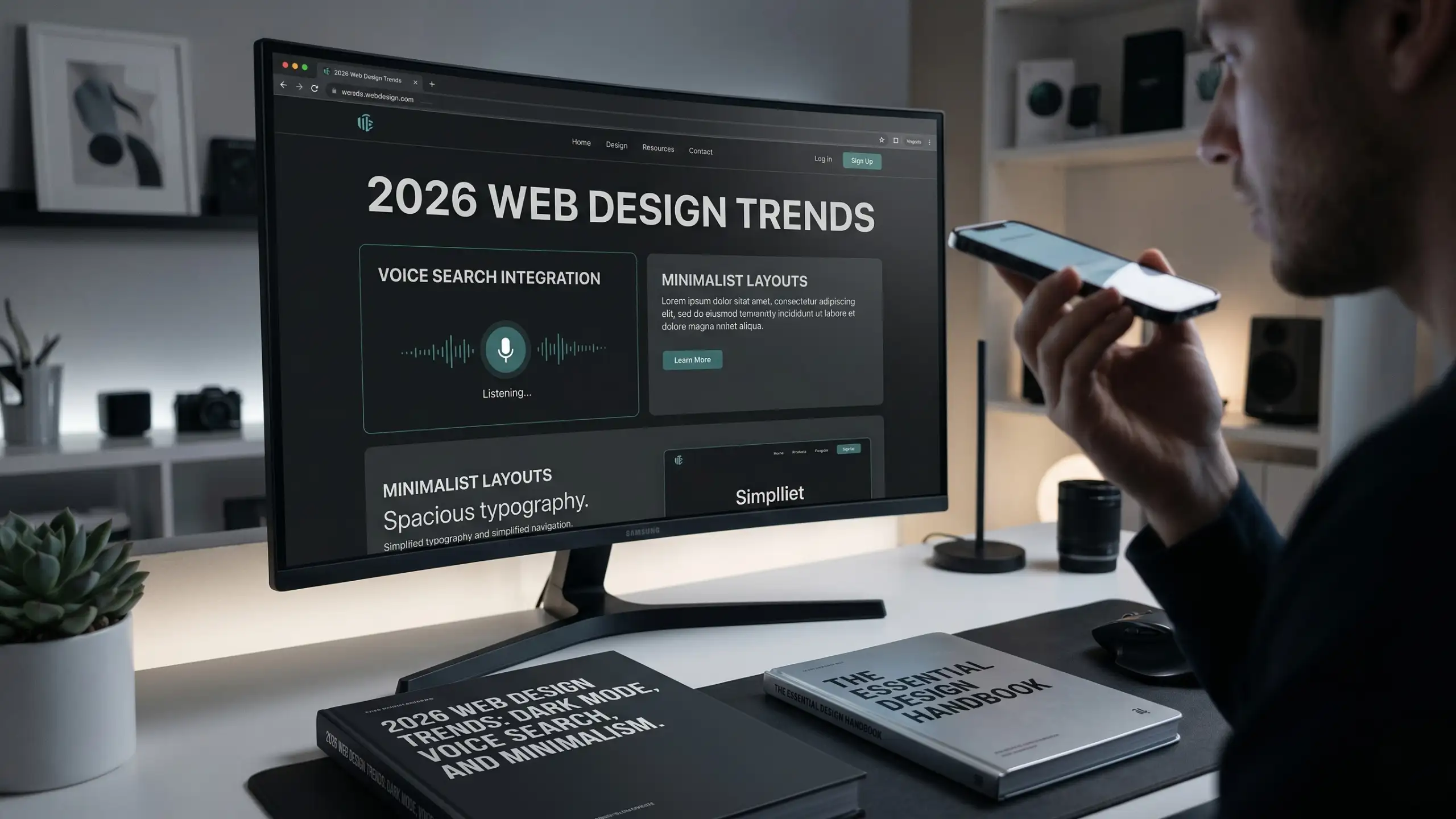
Dark mode, Voice search optimization and Minimalism are leading this transformation. Together they are designing a website that loads quickly, smarter and surprisingly human.
Dark Mode is Becoming The Standard
People no longer toggle dark mode just for fun. It is now a standard.
People are burning their retinas trying to navigate on frequently modified UI. Dark Mode is the way to go. Responds amicably to retina damage, increases battery life and the phone feels extremely cool and flashy when in a dark mode is turned on.
Beyond simply changing the design to dark mode, web designs have to think of how dark and light colors of designs might contrast with the light. A dark, muted blue in light settings might seem to disappear into the white page, whereas it may fluoresce gloriously in a dark mode.
Dark UI mode represents a challenge and an opportunity for businesses to consider the way in which their logos, images and UI components are reconfigured to satisfy both dark and light mode settings. When done right dark mode feels like a natural extension of the user’s environment.
Search UI Trend: Encouraging Users to Search Using their Voice
Typing is now a secondary option as Voice search is becoming more integrated into daily life. Voice modes of UI are most used application on Smart Phones, Smart Speakers or in Car assistants a users can easily speak their queries instead of typing..
This has a great impact on how websites are designed and optimized.
Because voice search is complex and designed with specific intent, users are more likely to look up, “Which company offers affordable web design services near me?” instead of typing, “best web design company near me”.
This forces SEO to adapt and work harder to maintain relevance to each voice search. Answering questions is taking the role of relevant content. Natural and conversational queries are winning the SEO. Voice assistants are picking questions users are most likely to ask, and
Website design Trends have shifted largely due to user content feedback. The appearance of the web is not just pages, they are playing a vital role.
Minimalism: Less is more.
In modern web design, simplicity serves a greater purpose, and is the goal of many busienss owners.
Users have even less patience in 2026 for websites with cluttered interfaces. They want web pages to be as fast, and as to the point as SEO and display Policies (and pop up advertising) allow.
Minimalist design provides:
- A clear design with ample white space.
- Not just spaces, a clean design with clear typography.
- A less cluttered palette of colors to enhance focus.
- Design that split out paths for better navigation.
I’ve seen that websites that use minimalism tend to be more trustworthy. Having a website that is neat and seay to navigate shows that you are serious and sells confidence. It shows that you care about the visitor’s time by saying, “We value your time and operate with purpose.”
The Relationship Between AI and Web Design
The relationship between Web Design Trends and AI is quite interesting.
The 2026 search engines are much more advanced. They are understanding the context as well as the user’s behaviour. That means the focus on web design and search engine optimization are more interconnected now.
Improving dark mode for the user’s experience helps keep the visitor from leaving. More minimalist websites lead to less complicated navigation creating a more enjoyable experience for the user and thus increases engagement. Optimizing for voice search will automatically lead to content that is more aligned with natural conversational cues.
These factor lead to an improvement in AI-driven search results.
Practically, businesses need to broaden their traditional search engine optimization. Instead of only focusing on rankings, businesses need to also focus on design and content for user experience.
Thinking Outside the Box: Designing With Visitors in Mind
Daily interaction with dozens of websites has led me to the conclusion that the most effective website is the one that is seamless and invisible to the visitor.
You don’t notice them because they just work.
A well-designed website in 2026 has many traits but one that stands front and center is that it gently guides you. It has the ability to predict what your next move is. It responds quickly to your requests.
If you are looking for a way to value user generated content this is it. Create an environment for your users to be real. This gives you real feedback, shows real interactions, and motivate you to shape your user experience in that way. Each design has to be supported by analytics, heat maps, user-testing, and some other tools that visualize the experience to the designers.
Design these days is not about assumptions. It’s about evidence.
Design Preferences vs. Performance
Though these trends are positive, they also come with certain number of challenges.
- Dark Mode Compatibility: Keeping things consistent across devices and platforms
- Voice Search Accuracy: Providing the AI with an easily understood front end to the backend.
- Balanced Minimalism: Finding a balance between simplicity that avoids the loss of content.
The businesses that will be most successful will be those that will find a balance. Too much minimal design can calso make the website feel empty. Dark mode, when overly or poorly designed can be very difficult to read. Leveling voice design can help capture a dying audience. A lack of balance causes a lack of growing audience.
Designing for the Rest of the 20s
The 2020s have highlighted that there is a human approach to designing websites. 2026 shows that if you can establish a balance web design truly has the capacity to lead in the digital world.
Technology has always had the same goal, regardless of how much it has changed, and that is to provide true and essential meaning to experiences by being intuitive, meaningful and accessible.
Respecting the user’s comfort, behavior and time is achieved through facctors, like:
Dark Mode.
Voice Search..
Minimalism.
These all uphold a user-first philosophy.
Conclusion
Web design in 2026 is less about creating creating web pages, and more like crafting experience. It’s a seamless blend of technology, art and a little bit of psychology.
For the companies like Codebee Lab that choose to remain competitive, choose either to adapt or fade into the background.
Lastly, invest in design that listens, works, and evolves. Because in a digital world, the most thought-out, user-centered experiences are often the ones that stand out from the rest.